Basement leak repair: fixing the one place water gets in
A leak with an address can often be repaired where it is, without a drain around the whole basement. The first step is finding out which kind of leak you have.
Seven places a basement lets water in
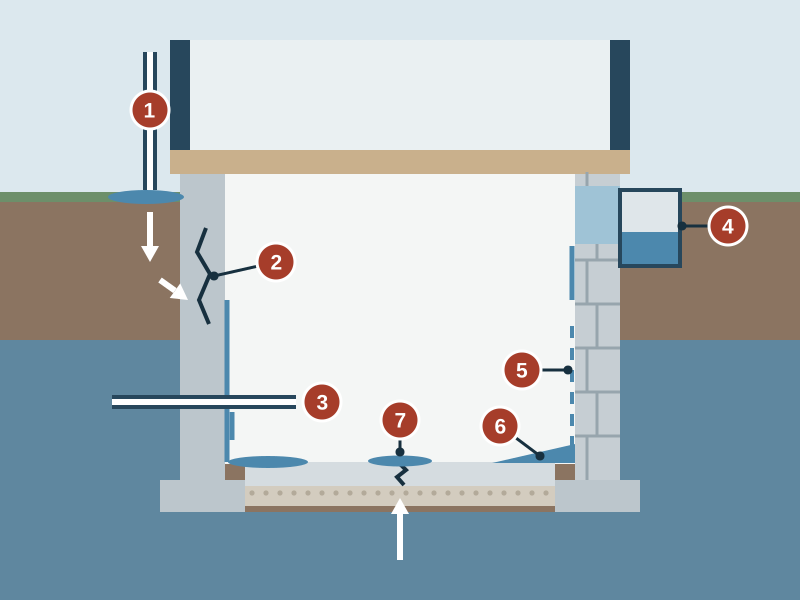
Section through a basement with a poured wall on the left and a block wall on the right.
- Downspout Roof water dropped beside the wall soaks straight down to the footing.
- Wall crack A crack in a poured wall leaks in a line, usually soon after rain.
- Pipe or cable hole The gap around a water pipe, sewer pipe or cable is a common drip point.
- Window well A well with a blocked drain fills like a bucket and spills over the sill.
- Block joints Hollow block walls fill with water and weep through the mortar.
- Wall-to-floor joint The seam around the edge of the floor lets groundwater up from below.
- Floor crack Water under the slab pushes up through cracks when the ground is full.
Leaks that can be fixed one at a time
A crack in a poured concrete wall. The standard repair is injection from indoors. Ports are fixed along the crack and a resin is pumped in until it fills the full thickness of the wall. Polyurethane stays flexible and suits a crack that leaks. Epoxy sets hard and is chosen when the aim is to bond the wall back together.
The gap around a pipe. Where a water or sewer pipe passes through the wall, the old packing shrinks. It is cleaned out and sealed with a flexible material, sometimes injected the same way as a crack.
A window well. The well is dug out, its drain cleared or a new one connected, clean stone put back and often a cover fitted. If the soil outside has risen above the bottom of the window, it is lowered.
Water over the top of the foundation. Soil or mulch piled higher than the top of the concrete lets water run in under the siding. The repair is a shovel, not a sealant.
Leaks that are really a drainage problem
Three of the seven do not respond to patching. Water at the wall-to-floor joint, water through floor cracks and water weeping from block walls all come from ground that is full. Seal one spot and it comes in at the next.
Those call for a drain and a pump. See interior drain tile.
Questions about a leak repair
- Is the crack leaking along its whole length or at one spot?
- Which material will you inject, and why that one?
- Does the warranty cover this crack only, and does it pass to a buyer if I sell?
- If water comes in beside the repair next spring, what happens?
- Would a longer downspout or lower soil outside solve this with no work indoors?
Leak repair questions
Will hydraulic cement from the hardware store do the job?
It can slow a seep for a while. It sets rigid, so when the wall shifts with the seasons the patch tends to crack loose at the edges. That is why companies inject a flexible resin into cracks that leak.
Does waterproofing paint stop a leak?
Masonry sealer can reduce dampness on a wall. It does not hold back water under pressure, and it blisters and peels wherever water gets in behind it.
Is a leaking crack urgent?
A slow leak that dries between storms is not. Move stored things off the floor, note when it leaks and have it looked at. Water that keeps rising is different: that needs pumping and drying by a water damage company before anyone repairs the wall.
Talk it through with a local company
Call and describe what the water is doing. You will speak with an independent local waterproofing company about coming out to look at your house.
For homeowners: basements, crawl spaces, sump pumps and drainage.
Call (262) 257-3901Racine Basement Waterproofing Help is a referral service, not a contractor. Calls may be recorded. Referral disclosure.