Crawl space encapsulation
Encapsulation closes a crawl space off from the ground and from outdoor air. In a town of basements the crawl space is often the part under an addition or an enclosed porch, easy to forget until the room above turns cold or musty.
What you notice first
- A floor that is cold underfoot all winter in one part of the house.
- A musty smell in the room above, strongest in humid weather.
- Insulation hanging down or lying on the soil when you look through the hatch.
- Water beading on ducts and pipes under the floor in summer.
None of these needs standing water. Bare soil gives off moisture all year, and an open vent lets in more.
What an encapsulated crawl space looks like
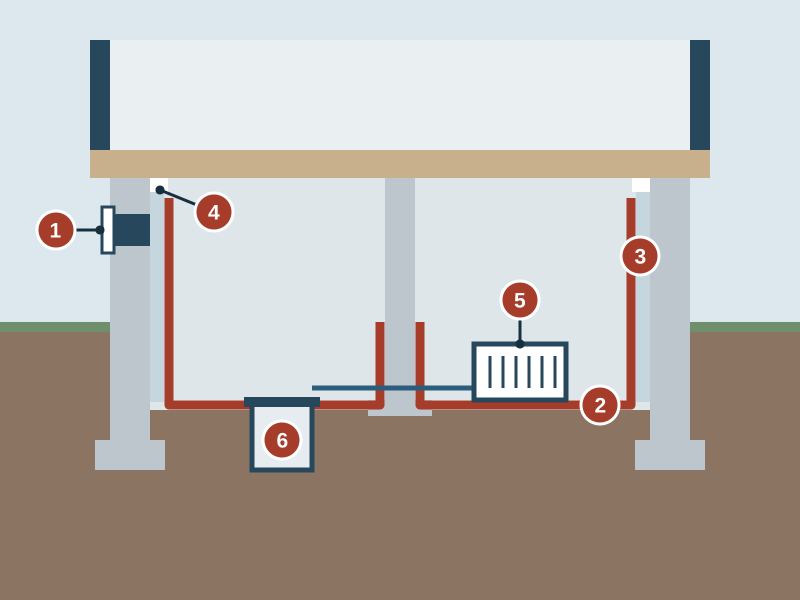
Section through a crawl space after the work.
- Vents closed Foundation vents are covered and sealed so humid air stays outside.
- Floor liner A thick plastic liner covers all the soil, with every seam taped.
- Liner up the walls The liner continues up the foundation walls and around each pier and is fastened near the top.
- Insulation and air seal Rigid insulation goes on the walls and the gaps above them are sealed.
- Dehumidifier Keeps the closed space dry and drains to the sump or outdoors.
- Sump or drain If water ever gets under the liner, it needs a way out.
Why closing the vents works
Vents were meant to air the space out. In a Wisconsin summer they do the opposite. Outdoor air carrying a lot of moisture flows into a space that is cooler than it is, and the moisture comes out on the joists, the ducts and the underside of the floor. A vented crawl space is at its wettest in July.
In winter the same vents let freezing air reach the pipes and chill the floor above. Sealing the space and insulating its walls brings it inside the house, where it stays close to room conditions all year.
What has to be put right before the liner goes down
Water
Puddles, or soil that floods in storms, need a drain and a pump first. See crawl space repair.
Leaks from above
A dripping pipe or a tub drain will pool on top of the new liner. Have a plumber fix it before the liner is laid.
Old insulation and debris
Wet batts, scrap lumber and anything sharp are cleared out so the liner lies flat and is not punctured.
Mold and damp wood
Joists are cleaned and allowed to dry. Wood that has gone soft is repaired, which may be a different trade.
Anything that burns fuel
A furnace or water heater in the crawl space draws its air from that space. Closing the vents changes its supply, so ask who checks it.
What the work is like
The crew goes in and out through the access hatch, which sometimes has to be made larger. Bags of old insulation come out and rolls of liner go in. It is quieter than basement work: no concrete is broken unless a sump basin is being set.
The dehumidifier needs a power outlet in or near the space and somewhere to drain. Afterwards, tell any plumber, electrician or cable installer that the liner is there, because one careless trip across it with a tool bag undoes a seam.
Full encapsulation or a plain vapor barrier?
A vapor barrier is a sheet of plastic laid over the soil. It is cheaper, it cuts the moisture rising from the ground, and it leaves the walls and vents as they were. For a dry, shallow space with sound wood it can be enough. Encapsulation adds the sealed walls, the closed vents and the dehumidifier, and is the step up when the floor above is cold or the wood reads damp. Ask the company for the moisture readings that justify the larger job.
Questions on encapsulation
- How thick is the liner, and is it reinforced?
- How are the seams, the piers and the top edge sealed?
- What happens to the vents and to the access door?
- Is a dehumidifier in the price, and where does it drain?
- What stops water collecting under the liner?
- Which gets insulated: the walls or the floor above?
- Who checks the furnace or water heater if one sits in the space?
Encapsulation questions
Is it worth doing for a small crawl space under an addition?
That depends on what the space is doing to the room above. If the floor is cold, the room smells musty or the joists are damp, sealing it helps. If the soil is dry and the wood is sound, a simple ground cover may be all it needs.
Can I store things on the liner?
Light storage is usually fine on a heavy reinforced liner. Ask first, and do not drag anything with a sharp edge across it.
Does the dehumidifier run all the time?
It runs when the humidity rises past its setting, which is mostly in warm weather. Like any appliance it needs its filter cleaned and its drain hose checked.
Talk it through with a local company
Call and describe what the water is doing. You will speak with an independent local waterproofing company about coming out to look at your house.
For homeowners: basements, crawl spaces, sump pumps and drainage.
Call (262) 555-0112Racine Basement Waterproofing Help is a referral service, not a contractor. Calls may be recorded. Referral disclosure.